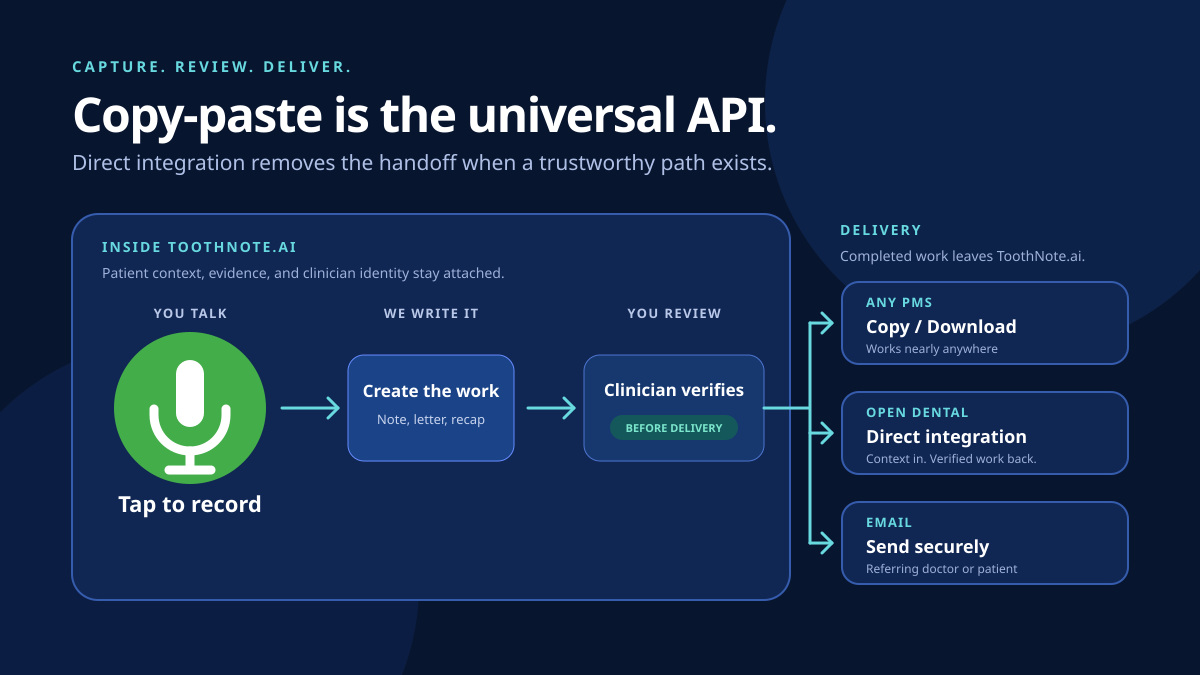
Copy-paste is the universal API.
That may sound like a joke coming from a software company. It is also one of the most practical product decisions we made.
Dental specialists use an enormous range of practice management systems. Some are modern and open. Some are older, closed, or highly customized. Many practices have spent years building templates, shortcuts, and habits around the system they already use. Asking them to replace all of that before ToothNote.ai can help is not a reasonable starting point.
So we started with a workflow that works nearly everywhere.
A clinician records the exam or dictates a focused update in ToothNote.ai. After review, the practice can copy or download the approved clinical note into nearly any PMS. An existing note can also be brought into ToothNote.ai when the practice wants to use it as source context for a referral letter or another supported document. No local installer. No data migration. No vendor project. No waiting for an integration agreement before the first useful result.
Copy-paste gave us compatibility on day one. It still matters, and we are not taking it away.
Why copy-paste came first
Every practice management system can display text. Almost every one can accept text somewhere in the patient record. That makes the clipboard a surprisingly durable bridge between systems that were never designed to work together.
For practices using MacPractice, WinOMS, and other systems where ToothNote.ai does not yet have an appropriate direct integration path, copy-paste remains the dependable option. It lets the practice keep its existing charting workflow while using ToothNote.ai for the specialist work around it.
That matters because interoperability is not useful if it only works for the newest software or the cleanest environment. A specialist should not have to change the system that runs the practice before ToothNote.ai can help.
It also keeps the human review step obvious. The clinician sees the completed note or document, approves it, and decides what enters the official patient record.
Copy-paste is not our legacy mode. It is our compatibility layer.
A referral letter is meant to travel
Copy-paste solved the chart handoff nearly everywhere. It did not finish the communication job.
A referral letter is not primarily a file for the practice to store. It is a message for the doctor who trusted the specialist with a patient. The highest-value path is usually the shortest honest one: the clinician reviews the letter, approves it, and sends it directly to that doctor by email.
Email is a first-class delivery channel in ToothNote.ai. When a practice verifies its email domain, the referring doctor can receive the letter from an address at the practice's own domain, with the practice's name and reply address. The recipient sees the office they know, not a generic software sender, and a reply goes back to the practice.
The same is true for patient letters. After the clinical note is approved, the practice can review the patient-facing explanation and send it directly to the patient. The note belongs in the clinical record. The referral letter belongs with the referring doctor. The patient letter belongs with the patient. They may begin from the same encounter, but they have different audiences and delivery jobs.
ToothNote.ai keeps those sends deliberate. The recipient is visible, the clinician reviews the artifact first, and the delivery state distinguishes a queued message from one the email provider has accepted or delivered.
The chart is one destination. The referring doctor and patient are destinations too.
Email closes one handoff. Integration closes another.
Direct email lets the finished communication reach the person it was written for. PMS integration addresses a different problem: getting context into ToothNote.ai and verified clinical work back into the chart without asking someone to move it manually.
Copy-paste still solves that chart handoff for almost any system. When a PMS gives us a sanctioned and reliable integration path, we can remove more of the repeated work without giving up the universal option.
That is what we are doing with Open Dental.
Why Open Dental is first
We love Open Dental because it treats interoperability like a real product surface.
Its documented integration path gives software partners a practical way to work with the patient record while letting Open Dental remain the practice's official system of record. We do not need to install a mystery agent on a workstation, ask the practice to open a firewall, or pretend that a fragile screen scrape is an integration.
That openness lets us build the kind of connection we actually want to support: explicit, practice-controlled, auditable, and honest about whether a read or write succeeded.
Our Open Dental integration is now approaching its first controlled release. That release is focused on the handoffs that repeat most often:
- Bring patient and referring-doctor context into ToothNote.ai without making the practice enter it again.
- Prefetch supported structured exam context so the next encounter can begin with useful information already attached.
- Return clinician-verified periodontal charting to Open Dental as a real perio exam, instead of asking someone to re-key the measurements.
- Continue toward filing approved ToothNote.ai documents into the patient chart with a visible delivery result.
The clinician remains in control. An unreviewed AI draft does not silently enter the chart. Approved clinical work travels only through an enabled connection, and the product should say whether it is queued, completed, or needs attention.
What this means during a clinical day
The value is not the number of delivery logos on a feature page. It is the disappearance of repeated work at the moment the practice needs to finish the job.
The clinician records the encounter once. ToothNote.ai prepares the clinical note, referral letter, and patient letter for review. The practice can send the referral letter directly from its verified domain to the referring doctor and send the patient letter to the patient. The clinical note can be copied or downloaded into nearly any PMS.
For an Open Dental practice, the patient and referring doctor can already be known when the clinician begins. Existing structured context can arrive with the case instead of being photographed, exported, or re-entered. A clinician can complete and verify a periodontal chart in ToothNote.ai and return those measurements to the chart where the hygiene and front-desk teams already work.
As document filing comes online, approved ToothNote.ai documents can return to the patient chart too. Email does not wait for that integration. It already closes the loop with the people outside the chart.
Three paths, one promise
These delivery paths are complementary, not stages that make the earlier ones obsolete.
- Send by email when the finished artifact belongs with a referring doctor or patient. For many high-impact documents, this is the preferred path.
- Copy or download when the practice needs a universal path into its PMS or network.
- Integrate directly when the PMS offers a trustworthy connection that can remove more of the handoff.
The product promise stays the same across all three paths: meet the practice where it is, keep the clinician responsible for the work, and deliver each approved artifact to the place or person it was created for.
We started with copy-paste. Now we are emailing and integrating directly, without forgetting why the universal path worked.