Every established dental practice has a quiet library of hard-won decisions. It lives in the way a doctor opens a letter, the order of an exam note, the details a treatment template never forgets, and the letterhead that tells another office exactly who sent the work.
Those choices are not clutter to clear away during onboarding. They are practice knowledge. A new tool should not make the team rebuild years of good habits inside a blank editor before it can be useful.
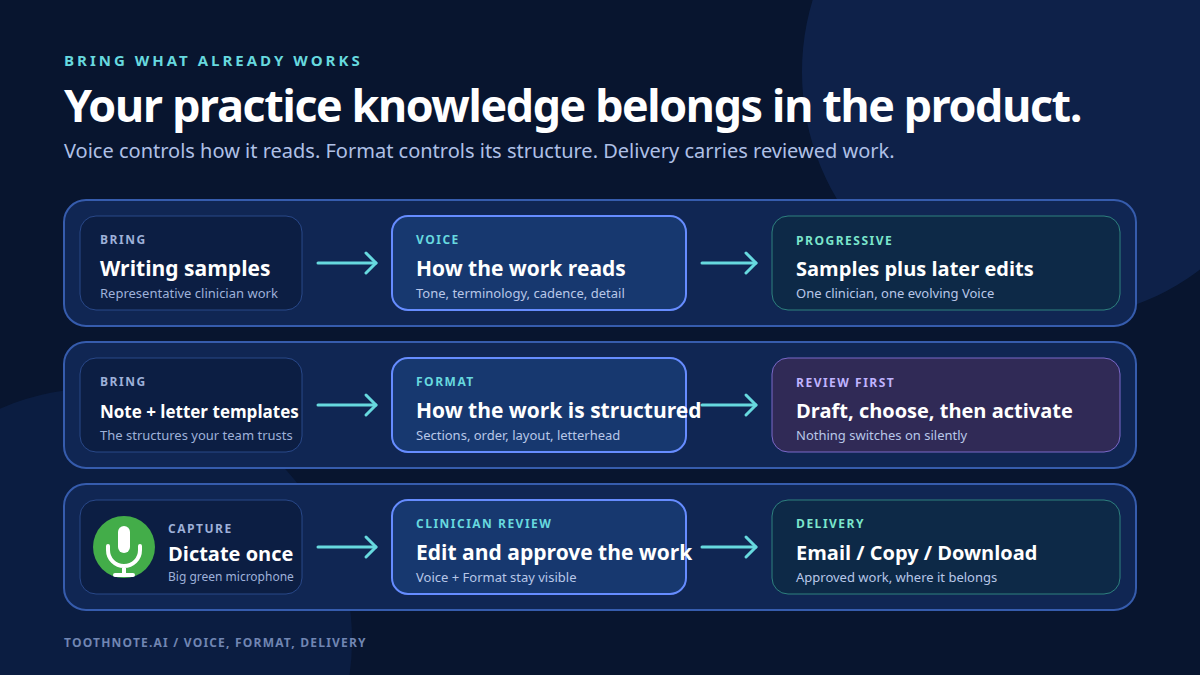
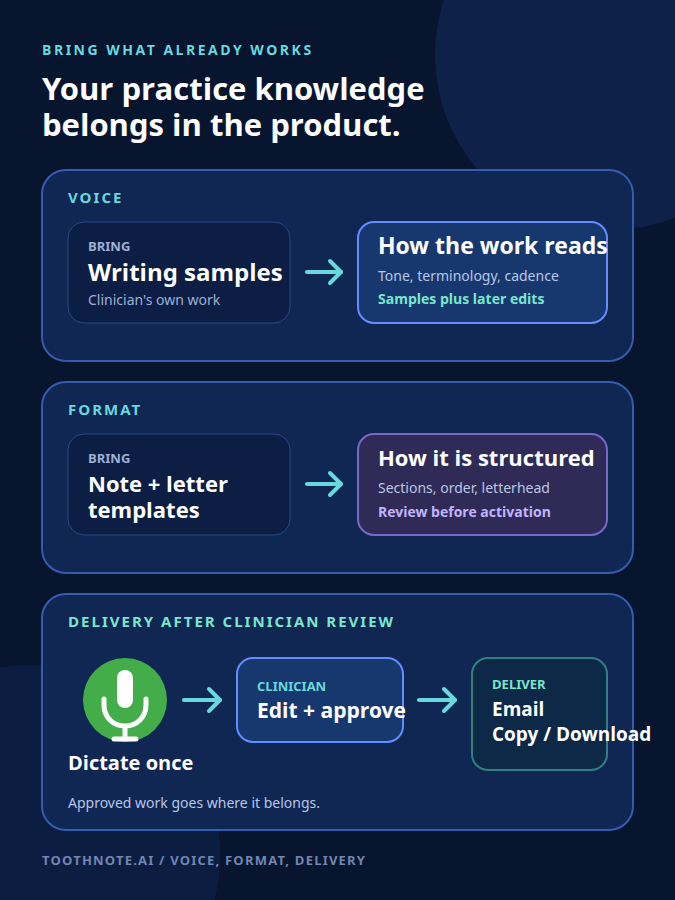
That is the idea behind Voice, Format, and Delivery in ToothNote.ai: bring what already works, use it to shape the drafts, and keep the clinician in control of what becomes active and what leaves the practice.
Bring how you sound
Voice is how the work reads. It includes a clinician's terminology, tone, cadence, level of detail, and the familiar patterns used to address a colleague.
A doctor can add representative writing samples to their own Voice. ToothNote.ai uses those samples, along with later edits, to tune that clinician's drafts over time. One sample does not instantly clone a person, and one clinician's samples do not become another clinician's Voice. The useful model is progressive: start with a real example, review the next output, and let repeated choices make the fit stronger.
This matters because "professional" is not one universal tone. A concise periodontist, a detailed oral surgeon, and a conversational endodontist can all write excellent letters without sounding alike.
Bring how you structure the work
Format is how the document is structured. It is the section set and order of an exam note, the shape of a treatment note, and the layout of a referral letter. PDF and DOCX are output types, not Format. Keeping that vocabulary clean makes the controls easier to understand.
A practice can begin with a built-in document structure, adopt a specialty starter, author a template, or bring an existing example into a reviewable draft. For Word letter templates, ToothNote.ai can identify familiar sections and fill-in slots while carrying supported embedded images such as letterhead. The uploaded file still lands in review. It does not silently become the practice default.
The same principle applies to exam and treatment notes. A template is a starting structure, not proof that a patient-specific detail occurred. The clinician reviews the resulting note, confirms the facts, and decides whether the structure is right for future work.
The practice should not have to choose between generic AI output and rebuilding every good decision by hand.
A familiar specialist workflow, without the reconstruction
Imagine a specialist who already has an exam-note structure the team trusts and a Word referral-letter layout the practice has refined for years. The team brings both into Format, reviews the drafts, and chooses the structures that should govern new work. The doctor adds a few representative writing samples to Voice.
During the next encounter, the doctor starts with the big green microphone and conducts the exam normally. ToothNote.ai prepares the clinical note and the letter back to the referring doctor using the selected structure and the clinician's evolving Voice. The familiar SOAP order is still there. The letter still opens, closes, and presents the practice the way the doctor expects.
Then the clinician reviews the work. They correct the clinical facts, adjust any language that does not sound right, and approve only the artifacts that are ready. Uploading a template did not bypass that responsibility. It removed the need to recreate the empty frame around the work.
Leave through the channel that fits
Delivery stays separate from Voice and Format. It is what happens after review: the output type the approved work becomes and the channel it uses to travel.
The practice can email an approved referral letter from its verified practice domain. It can copy or download approved work for nearly any practice management system. Where a supported direct connection is enabled, it can use that path for the work the connection supports. Changing the channel does not rewrite the doctor's Voice or rearrange the document's Format.
Keep the knowledge. Lose the grind.
Practices do not need another software migration disguised as an AI feature. They need a way to preserve the good decisions already embedded in their daily work while removing the repeated assembly around each patient encounter.
Bring the writing samples. Bring the note structure. Bring the letter layout. Review what ToothNote.ai learns from them, keep the clinician responsible for the finished work, and let the software carry the approved result where it belongs.
Keep what works. Leave the grind behind.