Understand what Voice controls
In ToothNote.ai, Voice means your writing style. It is the set of patterns that makes a clinical note or referral letter sound like you wrote it: your word choice, clinical terminology, sentence rhythm, level of detail, phrasing, salutations, closings, and the kinds of details you usually include.
ToothNote.ai learns these repeatable habits from prior notes and letters that you wrote or approved. When it generates new work, it uses those samples as examples of how you communicate. Voice should make the draft feel familiar without copying a prior patient or forcing every document to read exactly the same way.
Voice does not control SOAP sections, letter layout, treatment templates, file type, or sending method. Those belong to Format or Delivery.
Select the clinician
Voice belongs to the individual clinician. Confirm that you are configuring the doctor who will sign the resulting documents.
In a multi-clinician practice, each doctor should provide their own representative samples. Do not use one clinician's letters as the default voice for everyone.
Choose useful writing samples
Strong samples:
- Were written or approved by the clinician.
- Represent the type of document being tuned.
- Contain enough prose to reveal repeatable habits.
- Reflect wording the clinician wants ToothNote.ai to repeat.
- Have been de-identified when necessary.
Avoid samples that are:
- Atypical or one-off.
- Boilerplate written by another clinician.
- Full of language the clinician routinely removes.
- Too short to reveal meaningful style.
Add samples and review status
Paste text or upload supported examples. ToothNote.ai analyzes the samples and builds the clinician's Voice profile.
An uploaded document is evidence, not an automatic instruction. Confirm that it represents the language you actually want repeated.
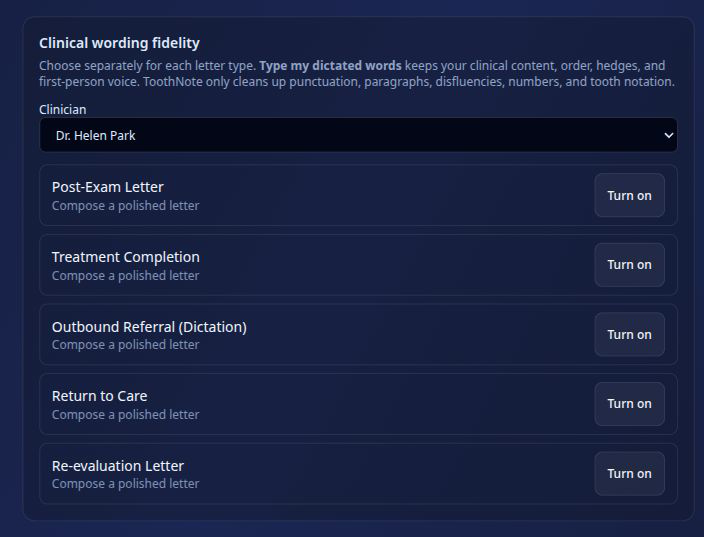
Choose clinical wording fidelity
Choose separately for each letter type. Type my dictated words keeps the clinician's content, order, hedges, and first-person voice while cleaning punctuation, paragraphs, disfluencies, numbers, and tooth notation. Compose a polished letter turns the same clinical evidence into more polished clinical prose.
Neither choice changes the clinician's responsibility to review the clinical content. Wording fidelity controls expression, not clinical truth.
Generate and compare a real document
Create a new referral letter or exam note from a real workflow. Compare the draft with the clinician's preferred work.
Look for:
- Familiar terminology.
- An appropriate level of detail.
- Natural openings and closings.
- Acceptable clinical phrasing.
- Anything that feels unlike the clinician.
Adjust one control at a time
If the wording is wrong, adjust Voice or its source samples. If the sections or organization are wrong, adjust Format. If the file type or sending method is wrong, adjust Delivery.
Expect different prose for different audiences
Sounding like you does not mean every document should read identically. The audience and clinical job still matter.
- Exam notes should remain clinically precise and chart-ready.
- Referral letters should sound like you communicating with a colleague.
- Patient take-homes should use clear language appropriate for the patient.
- Medical-clearance requests use controlled, standardized language.