The consultation went well. The patient understood enough to ask good questions. The doctor recommended a plan. Everyone left the room knowing there was a next step.
Two weeks later, the treatment is still unscheduled. The patient has a question about what was recommended. Someone at the front desk remembers a phone call, but the colleague covering today needs the details. The referring office is waiting for an update.
The practice has already invested in that relationship, that appointment and that clinical work. Carrying it forward deserves the same attention as bringing the patient through the door.
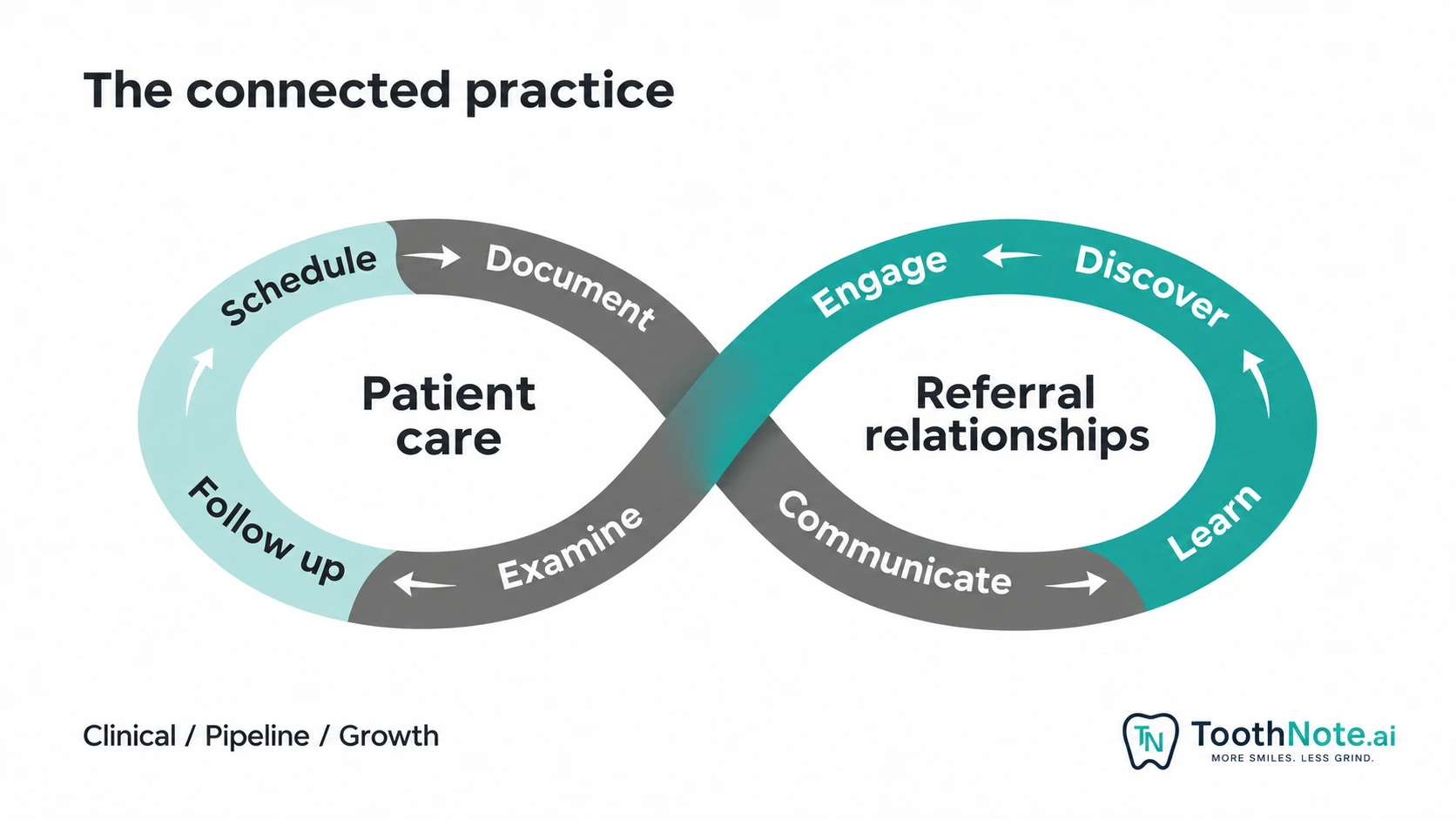
That is the idea behind the connected practice: make the clinical encounter useful to everyone who needs to act on it, and keep the next conversation connected to what came before.
Why the connection matters
A full appointment book can coexist with unfinished work. A proposed procedure may need another discussion. A cancellation may leave an opening while a suitable patient is waiting. A completed visit may still need a letter back to the referring doctor.
Each has a different consequence. The patient may be uncertain about the plan. Staff may spend another morning searching for context. The doctor may finish documentation after the last appointment. A referring office may have to call to learn what happened to its patient.
Those are practical places to look for improvement. Before adding another campaign or another report, ask whether the team can readily answer:
- Which treatment plans still need a conversation, and what happened on the last contact?
- When an appointment opens, who might fit that specific time and clinical need?
- Does the patient have a useful explanation of the findings and next step?
- Has the referring doctor received the update that completes their part of the handoff?
The value of a connected workflow is being able to act on those answers while the context is still useful.
Clinical, Pipeline and Growth belong in the same conversation
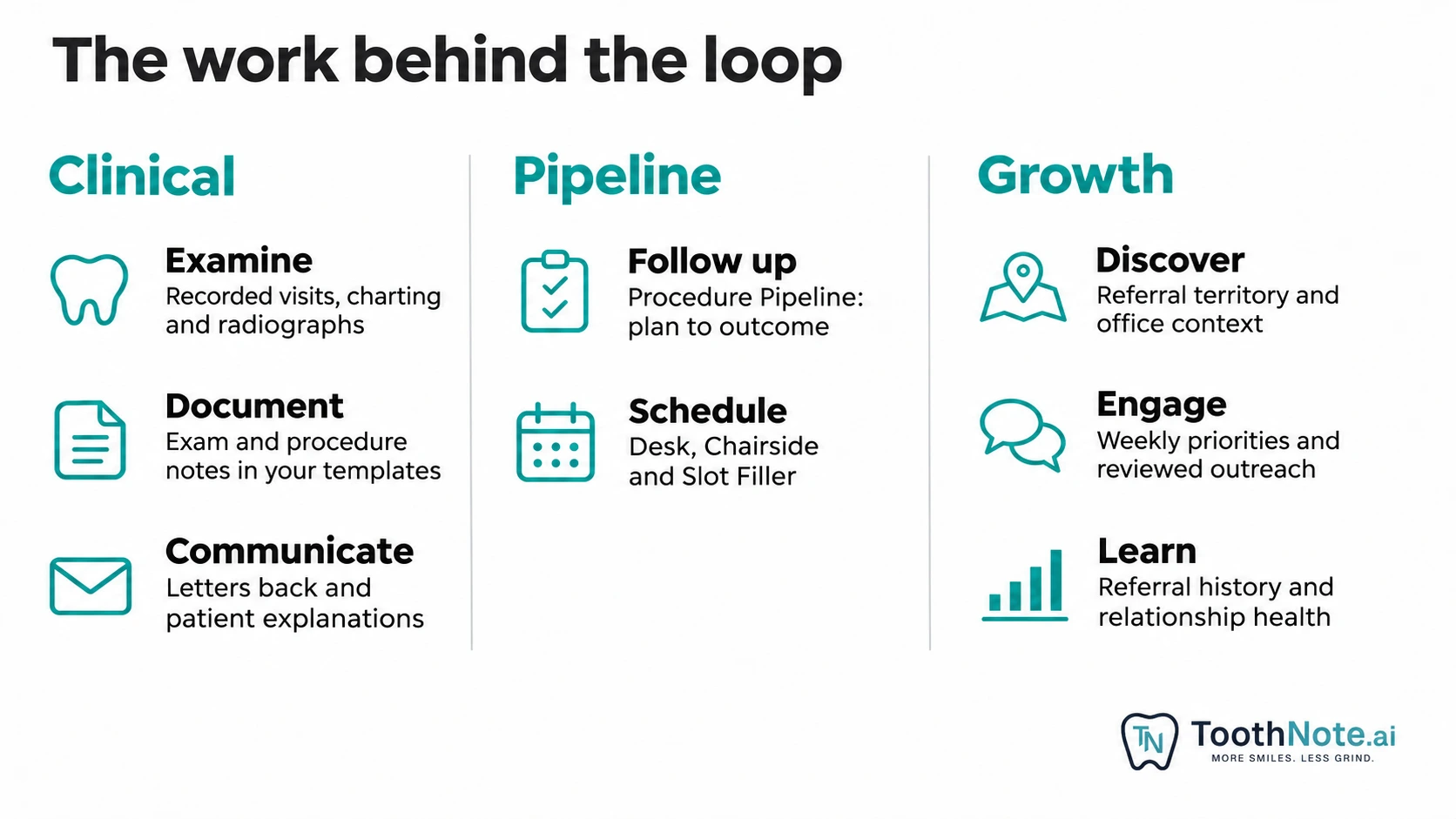
These are three connected kinds of work in ToothNote.ai. Together, they connect the clinical work that gives the encounter its substance, the plan that needs follow-through, and the relationship that brought the patient to the practice.
Clinical: let the encounter do more of the work
A follow-up conversation is stronger when the person making the call can understand what the doctor found and discussed. The same is true for a referring doctor receiving a letter or a patient trying to explain the visit at home.
Clinical documentation starts with the recorded encounter and supported case evidence to prepare a note in the practice's format for doctor review. That case can also support a referral letter and a patient explanation, with review before use or delivery.
This is where the breadth of ToothNote.ai becomes useful. The clinical work can support the office's documentation, the communication back to the referring doctor and the patient's understanding of the next step. The team has several jobs to finish, but they share a clinical source.
A patient take-home gives someone a personal, plain-language account of the reviewed findings and plan. It can support the later conversation with family or the next call to the office. The doctor remains responsible for the recommendation and final content.
Pipeline: turn an unresolved plan into a clear next action
A patient who has not scheduled may need an answer, time to decide, help finding an appointment or a conversation with the doctor. Knowing which of those applies changes what the team should do next.
Procedure Pipeline keeps unresolved treatment plans in view after the consultation, including plans from earlier months. Staff can record follow-up and distinguish work that is unscheduled, underway, booked, completed or declined.
That gives a covering colleague a place to pick up the conversation. A recorded decision to wait is useful information. So is a declined plan. Both deserve to be understood when the patient next calls.
Scheduling adds another practical connection. Desk helps the team prepare the day; Chairside connects the appointment with the patient case. When a block opens, Slot Filler brings the opening together with available treatment needs and preferences. Staff can review fit, contact the patient and record the result, with final booking in Open Dental.
The useful change is specific: an opening comes with a reason to make a particular call, and a treatment plan comes with a visible conversation to continue.
Growth: make relationship work more purposeful
An office sends its first patient. An established referrer becomes quieter. Your team is preparing for an office visit and wants a useful reason to reconnect.
Growth brings referral territory, available relationship history and weekly priorities into view. The team can choose where to focus, prepare outreach, review the message and record the activity.
For the person doing the outreach, that means starting with context: the relationship, the shared cases and the conversations already underway. For the practice owner, it creates a more concrete discussion about where the team's attention is going.
Clinical communication belongs in this picture too. A thoughtful introduction starts a conversation; a useful letter back gives the referring doctor something they need for a patient. Both represent the practice. Looking at them together makes relationship work part of the care workflow rather than a separate calendar of visits and emails.
What if our practice already has the tools?
We already have a practice management system
Keep it. Your PMS remains the official record for scheduling, billing and chart responsibilities. The question is where your team still has to move information, prepare a document or reconstruct a conversation around that record.
Supported connections can bring context into ToothNote.ai and return reviewed work through enabled workflows. For other systems, staff can copy reviewed note text or download a document for the appropriate chart workflow. Setup should establish the exact source, destination and staff action for your practice.
Our staff already follows up
That experience is an asset. Look at what happens when the usual coordinator is away, a patient calls back unexpectedly or an older plan needs attention again.
Can the next person see the previous conversation and its outcome? Can the team distinguish a plan needing follow-up from one already booked or deliberately declined? A useful system makes good staff habits easier to carry across shifts and people. The people still conduct the conversations and exercise judgment.
We do not need another system to maintain
The extra work is a fair concern. Start with one workflow and count the steps it requires from the team, including setup, review and any information they must enter twice.
Choose a concrete job: finishing referral letters, revisiting unresolved treatment plans or preparing calls for a real opening. Walk through it with the person who does that work. Compare how they find the context, finish the task and record the result today with the proposed workflow.
A useful demonstration ends with a finished piece of work and a clear account of what the team had to do. That is a better basis for a decision than the number of features on a page.
We want patients informed, not pressured
Follow-up should reflect the patient's actual question and decision. Someone may want clarification, need time or choose not to proceed. Recording that outcome helps the team respond appropriately.
The clinical note, patient explanation and next conversation should agree about what was recommended and why. ToothNote.ai prepares work for review; your doctor and staff remain responsible for the clinical decisions, the outreach and the booking. Clearer information supports that responsibility.
What does this mean for the business?
The business stakes are real: staff time spent locating information, clinical time spent rebuilding notes, appointment capacity left unused and proposed treatment whose next step is unclear.
There is a practical way to assess the opportunity in your own office. Keep the stages separate: treatment recommended, the patient contacted, an appointment booked, care completed and payment collected. Those events answer different questions. An unscheduled treatment total is a starting point for review; it is not money the practice has already earned.
Look at the reasons plans remain unresolved. Separate patients still considering their options from those awaiting an answer, a suitable appointment or further clinical discussion. Review what happens after the team follows up. Use completed care and actual collections when assessing financial results, and include the software and staff effort required to produce them.
The same discipline applies to referral relationships. Recorded activity and later referrals help the team understand the history. Their timing alone does not prove that an office visit or email caused a referral.
The point is to make the opportunity concrete enough to work on and the result clear enough to evaluate.
Start with the work your team keeps chasing
Choose one recurring interruption. Perhaps a referring office regularly calls for letters. Perhaps the treatment coordinator has to rebuild the history before making a follow-up call. Perhaps an opening appears and nobody has a useful place to begin.
Define what a better handoff would look like, who owns it and how you will know it happened. Start there, then connect the adjacent work as the team finds value.
You can begin with correspondence in Solo, add exam documentation and patient summaries in Pro, or bring Growth, Procedure Pipeline and scheduling together in Practice. Compare the workflows and confirm the relevant connections during guided setup.
Bring one unfinished handoff to the demonstration. We will work through what the doctor needs to review, what the staff needs to do and where the finished work goes.