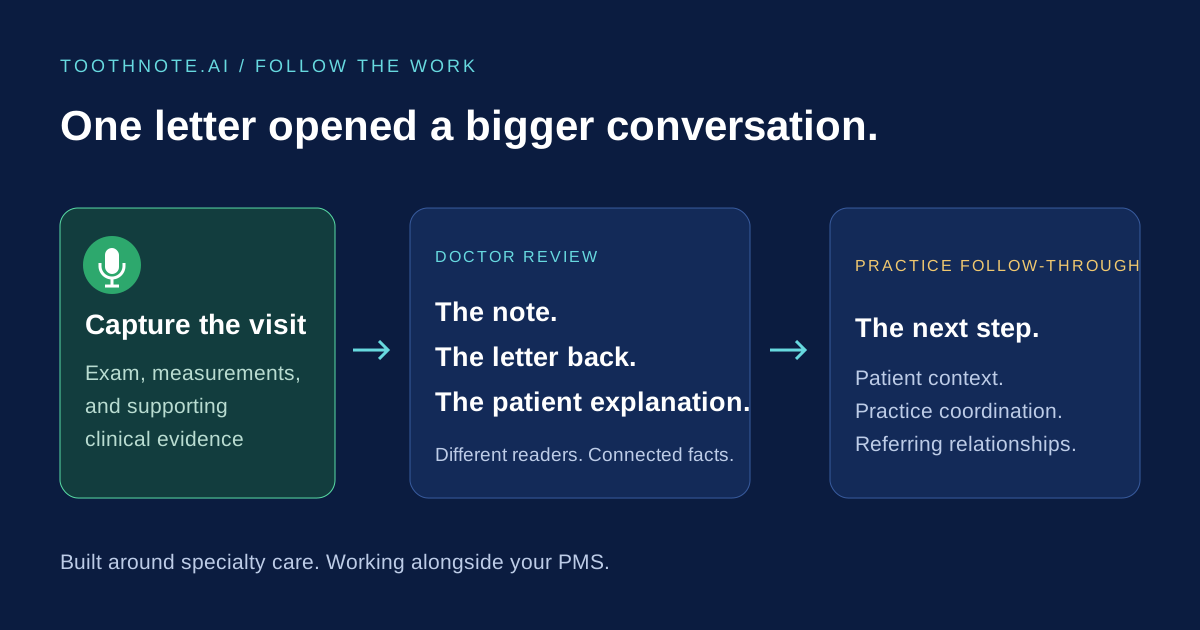
We started ToothNote.ai with a referral letter.
A specialist finished an exam, recorded a short memo, and received a draft letter back to the dentist who had sent the patient. The doctor reviewed it, made changes, and sent it. A small, useful job with a clear beginning and a clear definition of done.
That letter carried the findings, the treatment decision, and the next step. It helped the referring dentist understand what had happened to their patient. It was clinical work and relationship work at the same time.
Once we made that job easier, the work around it became impossible to ignore. The doctor had already examined the patient and explained the findings. Why reconstruct the encounter afterward? Why rebuild the same facts for the chart, the referring dentist, and the patient?
Move capture closer to care
We expanded from the short referral memo to recording the exam itself. The encounter could supply context for a clinical note, a letter back, and a patient explanation. We described that shift in our chairside recording story.
Then we went deeper into the clinical detail. A periodontal exam contains more than a sequence of pocket depths. Recession, bleeding, mobility, furcations, restorations, and other findings belong to particular teeth and sites. They also have a history.
Periodontal charting and the Patient Chart make that context easier to inspect. The doctor can review findings, correct them, and look back at prior examinations. That clinical foundation matters wherever the information goes next.
Make the document fit its reader
A chart note, a referring-doctor letter, and a patient take-home need different language, structure, and detail. A useful document gives its reader what they need to do next.
Our template system lets practices shape those documents around their work. Start with a specialist template or an existing document, then combine writing with relevant charts, images, and evidence. An educational image can help explain a procedure; it remains distinct from the patient's photograph, radiograph, or chart.
The doctor still reviews the clinical work. The software helps prepare it in a form that is useful to its reader.
Follow the work into the practice day
The encounter is part of a larger day. The front desk is preparing appointments. A cancellation creates an opening. A patient has treatment planned but no visit booked. Someone needs to know what happened after the consultation and what needs attention.
That is the purpose behind our scheduling views and Slot Filler: keep relevant context close to the staff member preparing the day or working an opening. Staff assess the fit, contact the patient, and complete the supported booking handoff. A suggested candidate is not a booked appointment.
Give relationships a place in the weekly routine
The first referral deserves attention. A longstanding relationship may go quiet. A conversation creates a follow-up that someone needs to remember.
The Doctor Chart and Growth tools bring relationship history and practice follow-through into view. Their purpose is to help the team decide where to spend its attention and prepare the next conversation. The practice owns those relationships; software cannot promise what any conversation will produce.
Alongside the systems your team already uses
The PMS remains central to the office. ToothNote.ai works alongside it, with supported connections and delivery paths confirmed for each workflow. Saving a reviewed note to a cloud folder, emailing a letter, and writing into a PMS are different actions. The integration page explains those distinctions.
Our ambition is to make specialty practices substantially more efficient and more deliberate about growth: less reconstruction, less repetitive writing, clearer patient communication, and more useful follow-through.
We began with one letter. The product grew by following the work that surrounds it.